Simulation on the open simulators is verified on Linux with the versions given. Vendor simulators are kit shipped (Vivado, Quartus) or modelled (Libero, Radiant): not yet run against them. Nothing is verified on Windows. Waveforms are on Waveforms; formal proofs on Formal proofs and equivalence.
Run testbenches
Each testbench of hdl.json appears in the Testing view, under HDL Testbenches, at the line that declares its top unit. Run it there.
"testbenches": [
  { "name": "adc_monitor_tb", "top": "adc_monitor_tb", "sources": ["tb/adc_monitor_tb.v"], "simulator": "icarus", "timeout": 120 }
]- Simulator: the one the testbench names (
verilator,icarus,ghdlornvc); otherwise GHDL for VHDL, and Icarus Verilog (or Verilator when Icarus is not installed) for Verilog. VHDL testbenches also run on NVC, by default when GHDL is missing. - Pass and fail: a testbench passes when it finishes with exit code 0 within its
timeout. It fails on$fatal,$erroror a VHDL assertion of severity error or failure, with the message and source location. Output goes to the test's output. - Working folder: the project folder, so the testbench's relative paths resolve as they do by hand.
- Waveforms: a VCD or FST the run writes is linked from the result. GHDL and NVC write an FST of every signal (
neuralInverse.hdl.simulation.ghdlWaveform,neuralInverse.hdl.simulation.nvcWaveform, both on by default). - Testbench macros: a testbench's
definesadds Verilog macros for it alone.
Extra arguments: neuralInverse.hdl.simulation.icarusArguments, simulation.verilatorArguments, simulation.ghdlArguments, simulation.nvcArguments.
State: verified (Linux) with Icarus Verilog, Verilator, GHDL and NVC 1.23.
cocotb
A testbench with a cocotb test module runs with cocotb 2 on Icarus Verilog, GHDL, Verilator (5.036 or later) or NVC (through its VHPI library), loaded as cocotb's own runner does.
{ "name": "safety_monitor_cocotb", "top": "safety_monitor", "simulator": "icarus", "cocotb": "tests/test_safety_monitor.py" }- Each
@cocotb.testshows under its testbench at its function and runs alone or with the others; tests the module makes at run time are added as their results come in. - A failure shows at the line that raised it, with its message and traceback. The variants of a parametrised test are reported together.
- The Python is
neuralInverse.hdl.cocotb.python, else the project's.venvorvenv, elsepython3. neuralInverse.hdl.cocotb.waveform(default on) writes a waveform of the design under test, linked from the result.
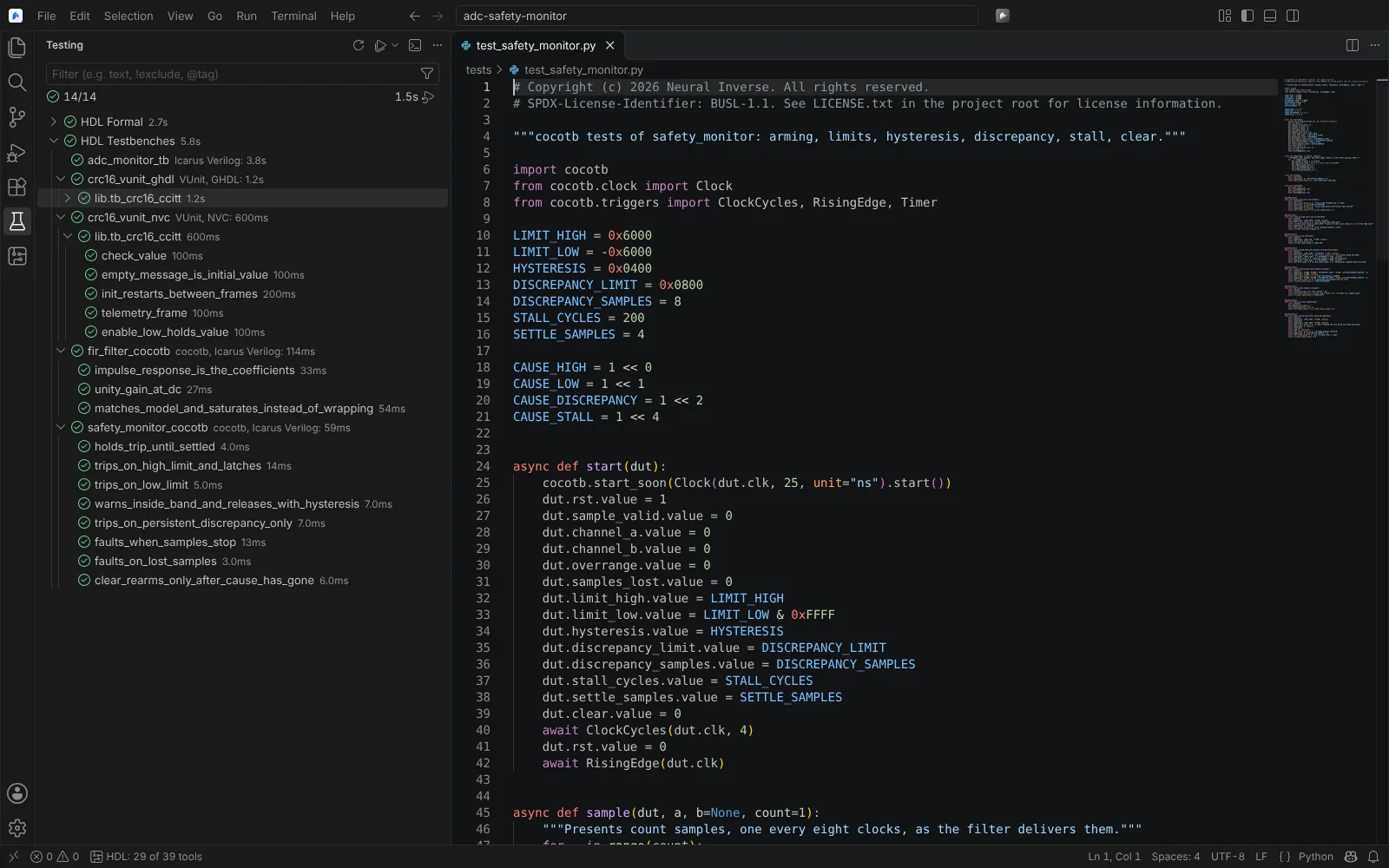 Testbenches, VUnit test cases and cocotb tests passing in the Testing view
State: verified (Linux) with cocotb 2 on Icarus, GHDL, Verilator and NVC.
VUnit
A testbench entry can name a VUnit run script instead:
{ "name": "crc16_vunit_ghdl", "vunit": "sim/run.py", "sources": ["vhdl/crc16_ccitt.vhd", "sim/tb_crc16_ccitt.vhd"], "simulator": "ghdl" }- The Testing view lists each test case of its testbenches at its
runline (fromrun.py --export-json). - Selected cases run on GHDL or NVC; each case's result, output and failures come from VUnit's JUnit XML. A failure the simulator does not locate is placed at the testbench line with its message.
- On GHDL, each test's waveform is linked from its output (VUnit has NVC write waves only in its GUI mode).
- Install VUnit with
pip install vunit_hdl. Settings:neuralInverse.hdl.vunit.python,vunit.arguments(for example-p 4or--fail-fast),vunit.waveform.
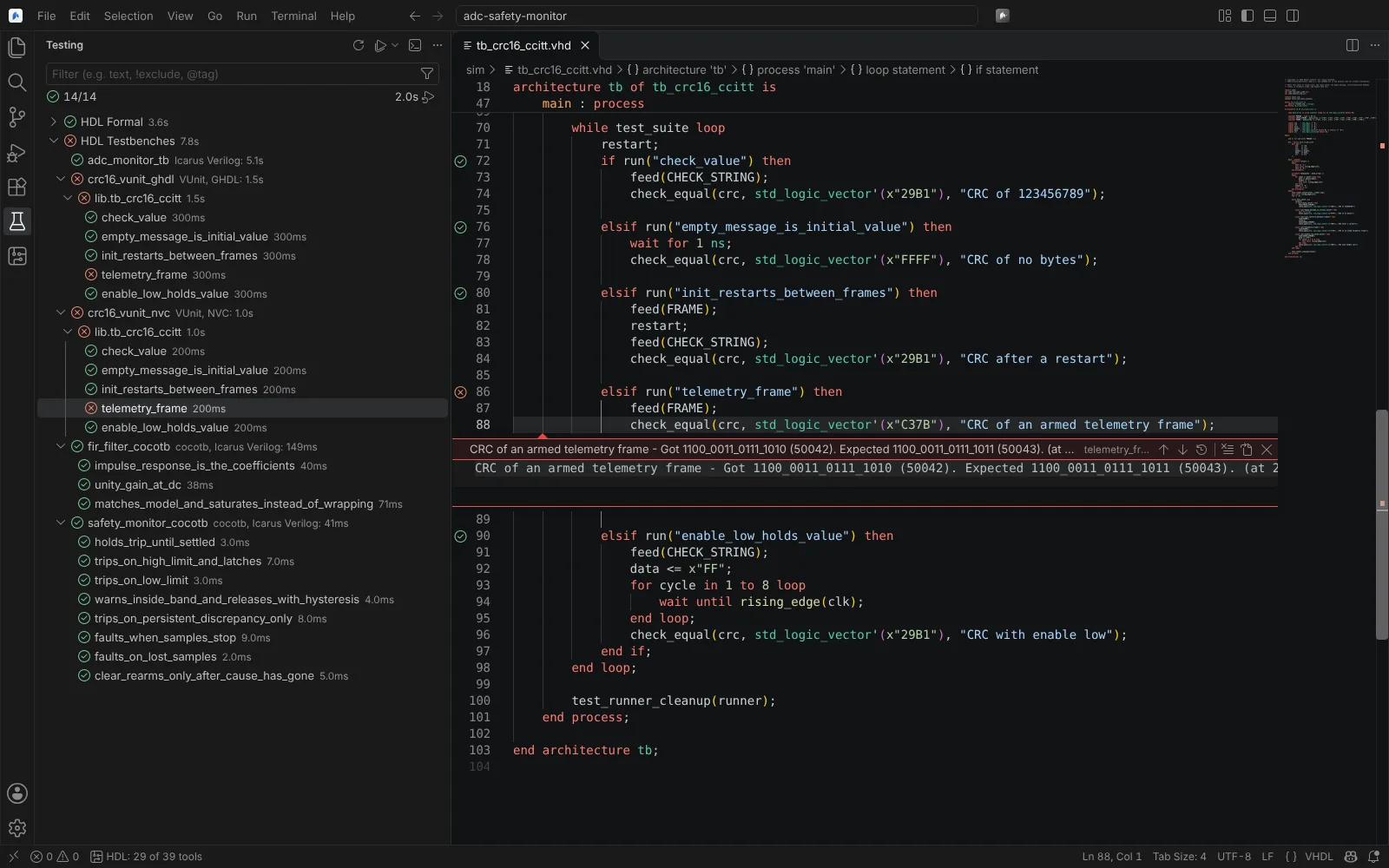 VUnit test cases at their run lines, one failing check with the values it compared
State: verified (Linux) with VUnit 4.7.1 and 5.0.0.dev14 on GHDL 4.1.0 and NVC 1.23.0.
Vendor simulation
Simulation sets imported from a Vivado .xpr (sim_1) and test benches from a Quartus .qsf become items in the Testing view, next to the open-simulator testbenches. Each runs in the vendor simulator with the vendor libraries resolved from your install; the testbench decides pass or fail. A testbench's vendor block in hdl.json names the target, simulator, stage, timing, run time, simulation set, wave configuration and extra arguments.
| Vendor | Simulators and stages | State |
|---|---|---|
| Vivado | XSim behavioural, post-synthesis and post-implementation, functional or timing, with the netlist and SDF written by Vivado; Questa against compile_simlib libraries with a generated modelsim.ini; Riviera-PRO, Xcelium and VCS (behavioural) through export_simulation | Kit shipped; Riviera, Xcelium and VCS logs not checked on real output |
| Quartus | Questa-Intel FPGA Edition with the simulation scripts IP generation writes (qsys-generate --simulation, ip-make-simscript, msim_setup.tcl) | Kit shipped; Altera atom library names not checked on a real install |
| Libero | QuestaSim or ModelSim Microchip edition with the Microchip precompiled libraries, behavioural and post-synthesis | Modelled; the library path not checked on a real install |
| Radiant | Questa with Radiant's precompiled family library and pmi_work, behavioural and post-synthesis | Modelled; library folders not checked on a real install |
XSim waves open in the Editor's waveform viewer, laid out from the project's .wcfg: the .wdb database is proprietary, so the run also writes a VCD, and the Editor says so. See Waveforms.
Compile simulation libraries
Compile Simulation Libraries builds the vendor libraries for a simulator: compile_simlib for Questa, Riviera-PRO, Xcelium and VCS from Vivado, or quartus_sh --simlib_comp from Quartus. neuralInverse.hdl.simulation.compiledLibraries names the folders of compiled libraries by simulator (questa, riviera, xcelium, vcs), often a shared folder your company keeps per tool release. A vendor testbench whose libraries are not compiled fails with a message saying so.
State: kit shipped. Every generated command line, project and script line is tested, and the parsers on real xsim, xelab and vsim logs and real .wcfg files; no vendor simulator has been run.