The Automotive module is for network, ECU software, validation, diagnostics, calibration and AUTOSAR integration engineers at OEMs and suppliers. It brings the work they do in CANoe, CANalyzer, CANdb++, CANape, INCA, vFlash, CANdelaStudio, DaVinci, vTESTstudio, PCAN-View and Kvaser CanKing into the Editor: network databases as languages with checks, the bus itself through Vector, PEAK and Kvaser interfaces, traces, rest-bus simulation, J1939, LIN, FlexRay and automotive Ethernet, UDS diagnostics and reprogramming on CAN, over DoIP or through a VCI, measurement and calibration over XCP, tests, panels and requirements coverage, and the BSW, software component and Adaptive AUTOSAR configuration. Vendor interfaces and tools are driven through the vendor's own library or command-line tool that you installed; nothing of a vendor is bundled. For a short summary of every domain module, see Domain modules.
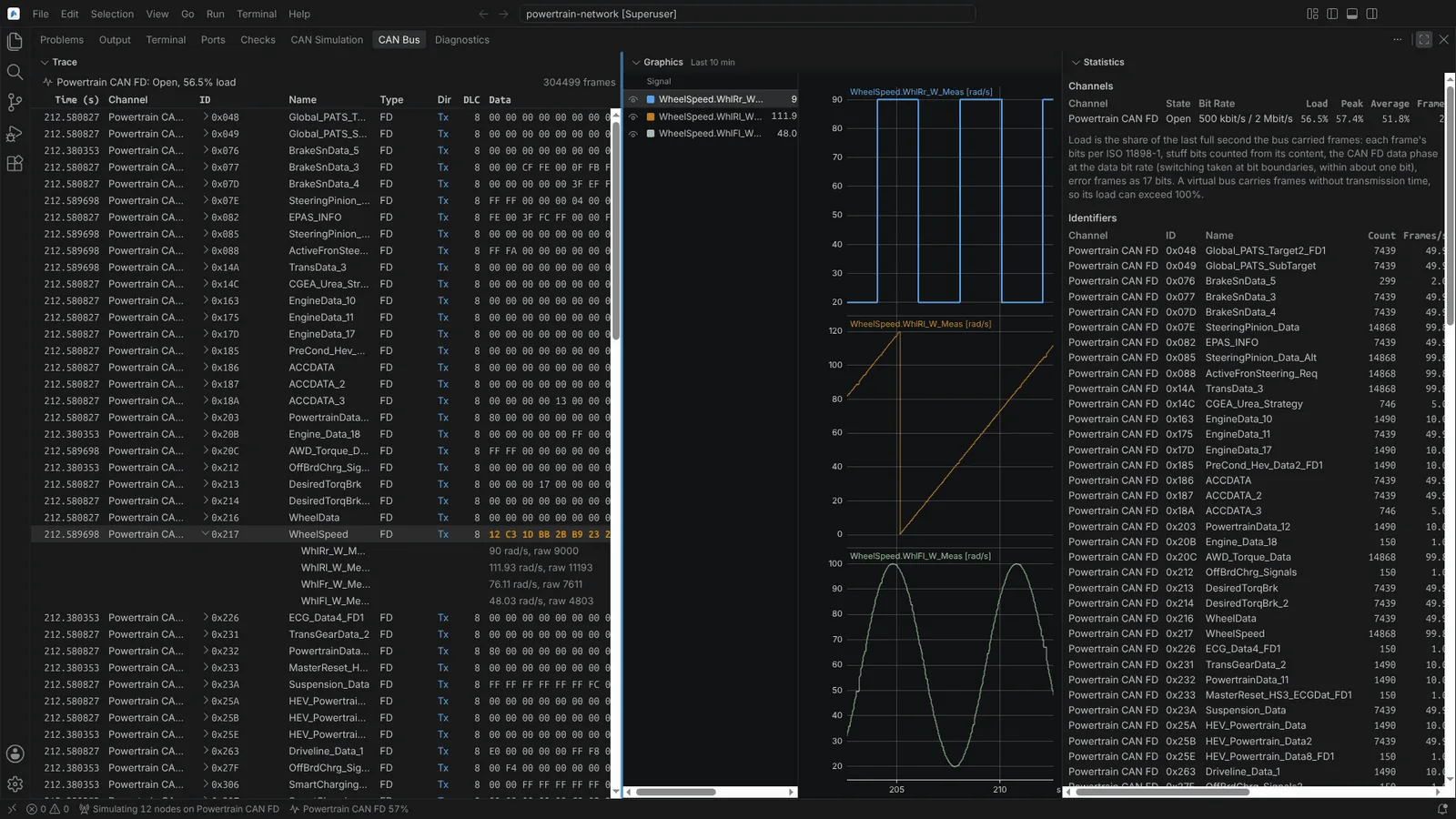 The CAN Bus panel with the decoded trace, live signals in the graphics view and bus statistics on a CAN FD channel.
Verification state: read this first
The module is pre-release. Everything below was tested on Linux in a container.
- No CAN, LIN or FlexRay hardware (no Vector, PEAK, Kvaser, IXXAT or slcan adapter, no VCI) and no real ECU were available.
- No vendor library or tool was installed: the Vector XL Driver Library, PCAN-Basic, PLIN-API, Kvaser CANlib and LINlib, a D-PDU API, CANoe4SW Server Edition and DaVinci Configurator ran only against test libraries or stand-ins written from the vendors' published interfaces. Verification kits run them against the real libraries and tools on your machine.
- No SocketCAN: the kernel had no CAN support.
- Windows and macOS are untested, except the vendor helper processes' Windows binaries under Wine.
- No customer project has been tried. Readers were checked on vendor and standards-body sample files, which are demo size (the largest DBC has 33 messages, the largest communication description 3 frames, the largest A2L 32 measurements).
- Nothing the module writes has been opened by the vendor tool it is meant for (CANdb++, CANoe, CANalyzer, CANape, INCA, PCAN-View, vFlash, DaVinci).
| State | Meaning |
|---|---|
| Modelled | Built and tested against a model: test libraries written from a vendor header, a simulated ECU, stand-ins that print the vendor tool's published output, community or generated files |
| Kit shipped | As modelled, and a verification kit runs the same inputs on the real vendor tool or library; waiting for its report |
| Verified | Run against the real vendor tool or library, with edition, version and operating system recorded. For the module's own readers: checked on files a vendor tool wrote or a vendor or standards body published, against an independent implementation |
| Verified by a customer | Run by a customer's engineer on their own project |
No capability is verified by a customer. Work on a bench only: never on a vehicle, and never on a network other people are using.
What it covers
| Area | Capability | State | Page |
|---|---|---|---|
| Databases | DBC language, 22 checks, navigation, rename | Verified on vendor samples (demo size) against cantools | Network databases |
| Databases | CAN Database view and DBC editing in CANdb++'s formatting | Reading verified; writing modelled | Network databases |
| Databases | Codec: every multiplexing form, CAN FD, 64-bit signals | Verified on vendor samples | Network databases |
| Databases | CAN database compare | Modelled | Network databases |
| Databases | LDF language and checks | Modelled | LDF and ARXML |
| Databases | ARXML: CAN, J1939, LIN and FlexRay clusters, container PDUs, 68 checks, schema validation | Verified on vendor samples (3 frames) | LDF and ARXML |
| Databases | New databases from templates, communication matrix export and import, AUTOSAR channel to DBC | Verified on vendor samples | Templates, exchange and C code |
| Databases | C code generation | Verified with gcc and clang | Templates, exchange and C code |
| Bus | CAN interfaces: Vector, PEAK, Kvaser | Kit shipped | CAN channels and the bus monitor |
| Bus | CAN interfaces: python-can; virtual bus | Verified on python-can's virtual interfaces; virtual bus verified across processes | CAN channels and the bus monitor |
| Bus | slcan adapters | Modelled | CAN channels and the bus monitor |
| Bus | Live bus monitor: Trace, Graphics, Data, State Tracker, Statistics, recording | Verified on the virtual bus and python-can | CAN channels and the bus monitor |
| Traces | Trace reading | Verified on Kvaser and CSS Electronics files | Trace files |
| Traces | Trace writing, trace editor, ISO-TP annotation, signal plot, replay | Modelled | Trace files |
| Simulation | Rest-bus simulation, interactive transmit, fault injection, CAN network management, CAN and Ethernet together | Modelled | Rest-bus simulation |
| Simulation | AUTOSAR E2E and SecOC | Modelled | E2E and SecOC |
| Networks | SAE J1939 | Decoding verified on vendor logs; transport protocol modelled | J1939 networks |
| Networks | LIN channels, master and slave emulation, node configuration, UDS over LIN | Vendor LIN kit shipped; virtual LIN modelled | LIN bus |
| Networks | FlexRay clusters and FlexRay recordings | Verified against independent readers on written descriptions | FlexRay |
| Networks | Ethernet traces, SOME/IP, service discovery, DoIP in captures, link load, live capture, SOME/IP node, topology | Modelled | Automotive Ethernet and SOME/IP |
| Networks | DLT logs | Modelled | DLT logs |
| Diagnostics | ISO-TP and UDS, Diagnostic Console, DoIP, VCIs through the D-PDU API | Modelled; D-PDU API kit shipped | Diagnostics |
| Diagnostics | ODX and PDX descriptions; CDD | ODX and PDX verified on vendor examples; CDD modelled | Diagnostics |
| Diagnostics | Reprogramming, ODX-F, memory verification, flash jobs, end-of-line sequences | Modelled; OEM seed-key library kit shipped | Reprogramming and end of line |
| Diagnostics | Diagnostic tests generated from the description | Modelled | Diagnostic tests |
| Calibration | A2L, XCP measurement and calibration, MDF 4 recording and analysis, parameter sweeps | Verified against Vector's XCPlite (MIT) as the ECU | Calibration over XCP |
| Calibration | ECU images, data sets (DCM, CDF 2.0), compare and merge | Modelled | Calibration data and the A2L update |
| Calibration | A2L addresses updated from the ELF or map file | Verified against readelf, pyelftools and a2ltool | Calibration data and the A2L update |
| Test | CANoe projects, CAPL, CANoe4SW Server Edition builds and test runs, test variants | Readers verified on Vector's published files; CANoe runs kit shipped | CANoe projects and CAPL |
| Test | Test design: test tables and sequences | Native runs modelled; compiled units kit shipped | Test design |
| Test | Requirements traceability from ReqIF | ReqIF reading verified on public files | Requirements coverage |
| Test | Panels | Modelled | Panels |
| AUTOSAR | BSW configuration (ECUC), DaVinci validation, generation and update | ECUC reading verified; DaVinci kit shipped | BSW configuration |
| AUTOSAR | Software components | Verified on public ARXML against autosar-data | Software components |
| AUTOSAR | Adaptive manifests | Verified on public ARXML against autosar-data | Adaptive manifests |
| Governance | Confirmations, records, 107 agent tools | Modelled | Approvals and audit |
| Interchange | Round trip of vendor files, files written for vendor tools, vendor wording | Modelled | Vendor tools and interchange |
What is not built yet is listed in What's next.
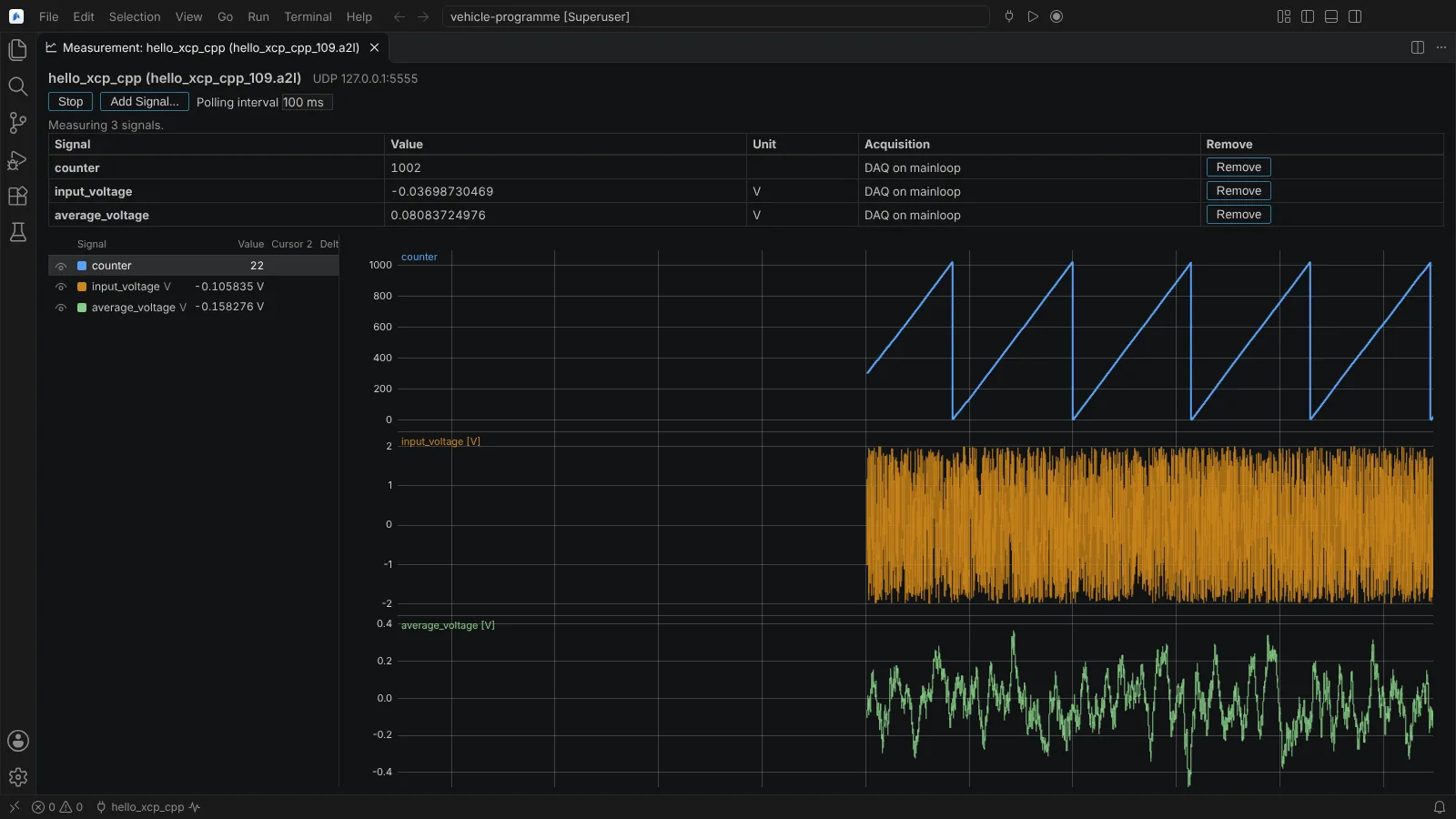 A measurement window over XCP showing three signals from the A2L acquired by DAQ and plotted live.
How the module runs
- It starts by itself in a trusted workspace that holds automotive work: DBC, LDF, ARXML, A2L, CDD, ODX or PDX files, CAN traces, Ethernet captures or a CANoe project. There is no setting and no offer. See Set up.
- Vendor libraries in a helper process. The Vector XL Driver Library, PCAN-Basic, PLIN-API, Kvaser CANlib and LINlib, OEM seed-key libraries and D-PDU APIs are loaded only by helper processes of the Editor, without Python.
- Every action that changes an ECU or sends on a real bus asks first, naming the ECU or channel, its interface and the change. See Approvals and audit.